Semi-Automated Offside at WC26: The Tech, the Limits, the Controversies Already Brewing
How FIFA's connected-ball, 29-data-point semi-automated offside system actually works in 2026 — and the centimetre calls that will define the tournament.
The first time most fans saw it, they did not even realise what they were looking at. Argentina vs Saudi Arabia, 22 November 2022. Lionel Messi rolls a finish into the bottom corner, the net ripples, the bench bursts out, the world begins to celebrate the third Argentina goal of the half — and within twenty seconds, a small Adidas-branded graphic blinks onto the broadcast. A pixel-thin line is drawn across Lautaro Martínez's torso. Goal disallowed. No flag, no manual line-drawing, no VAR-room horseplay with screenshots. The decision came out of a server.
That was the public debut of FIFA's semi-automated offside technology (SAOT). It worked, it was controversial, and it permanently changed how offside is judged at the World Cup. At WC26, SAOT is the default at all 16 venues, plugged into an upgraded Connected Ball platform and an officiating workflow that has been rebuilt around it. This piece is an honest tour of how the system works, where the limits are, and which controversies are already lining up for the group stage.
A brief history of the offside flag
For most of football's history, offside was decided by a single human standing on the touchline with a flag. The assistant referee's hardest job — and the one with the least margin for error — was holding still long enough to compare the position of the attacker, the second-last defender, and the moment the ball was played, all at once, all from a flat angle, often at twenty metres' distance.
The flag worked. It also, by FIFA's own admission, was wrong about 8% of the time on the tightest calls (FIFA technical bulletin, 2022). After VAR was introduced at Russia 2018, the offside review process exposed how often the human eye got the close ones wrong — and how slow the manual correction was. A typical 2018 World Cup offside check took 70 to 90 seconds, with VAR officials freezing the frame at the moment of the pass and dragging digital lines across the pitch by hand.
The arrival of SAOT at Qatar 2022 cut that to roughly 25 seconds average, per FIFA's post-tournament technical report. WC26 aims to push it further still.
- 1
Goal-line technology approved by IFAB
The first major technology breakthrough in football officiating. Sets the precedent that hardware can override human eyes for factual decisions.
- 2
VAR debuts at Russia World Cup
Manual offside line-drawing introduced. Reviews routinely take 70-90 seconds. Fans learn the phrase 'clear and obvious error'.
- 3
FIFA Arab Cup pilots SAOT
First competitive test of the multi-camera tracking and connected-ball system. The technical validation FIFA needed before Qatar.
- 4
SAOT live at the World Cup
12 dedicated tracking cameras per venue, 29 data points per player, IMU sensor in the Adidas Al Rihla ball pinging at 500 Hz. First high-profile call: Lautaro Martínez vs Saudi Arabia.
- 5
IFAB ratifies SAOT in Laws of the Game
Codified as an approved technology for member confederations. Premier League trials begin.
- 6
Connected Ball v2 announced
Improved 'armpit precision' calibration after fan complaints over centimetre-thin disallowed goals.
- 7
WC26 kicks off with SAOT at all 16 venues
First men's World Cup where every host city is fitted with the full SAOT camera array from the opener at Estadio Azteca onwards.
How the system actually works
There are four layers, and they all have to talk to each other in real time. Strip any one out and SAOT degrades to a manual VAR check.
Layer 1 — The cameras
Each WC26 stadium is fitted with a dedicated array of 12 high-frame-rate tracking cameras mounted in the roof structure, separate from the broadcast cameras. They run at 50 frames per second. Their only job is to feed the SAOT computer, not the broadcaster.
The cameras triangulate 29 data points on every player on the pitch — fingertips, elbows, shoulders, hips, knees, toes — at 50 Hz. That gives a 3D skeletal map of all 22 players plus the four officials, ten times every fifth of a second. The data is anonymised by jersey number (the system does not need to know it is Mbappé; it needs to know it is the player at position (x, y, z) wearing number 10).
Layer 2 — The ball
The Adidas Trionda match ball used at WC26 contains an inertial measurement unit (IMU) sensor suspended at the geometric centre of the ball by a fine wire harness — the same architecture introduced in the Al Rihla ball at Qatar 2022 and refined since. The sensor transmits position and motion data at 500 Hz (500 readings per second) to local receivers around the stadium.
Why does the system need ball data when it already has camera data? Because the offside law cares about a precise moment: the instant the ball is played by the attacker's teammate. Camera data alone can be ambiguous about that exact frame. The IMU registers the kick as a sharp spike in acceleration. Cross-referencing camera and ball data lets the system pin down the offside moment to a single 2-millisecond window.
Layer 3 — The AI bone-tracking model
The 29 tracked points per player are fed into a machine-learning model that infers the full body skeleton — including parts the law cares about (any part of the body that can legally score a goal, which excludes the hands and arms below the armpit). The model has been trained on tens of thousands of hours of professional match footage and refined with the 2024 "armpit precision" upgrade, which improved how cleanly the system distinguishes shoulder from upper arm.
This is the layer fans see in the rendered 3D animations on the broadcast: the silhouettes of attacker and defender, the offside line drawn through the relevant body part of the second-last defender, the colour-coded indication of which body part of the attacker is beyond the line.
Layer 4 — The alert to VAR
If the system detects a possible offside, it pushes an automated alert to the video match official within roughly 3 to 8 seconds of the ball being played. The alert includes the proposed offside line, the attacker's relevant body part, and a confidence score. The VAR official verifies the call — they are still the human in the loop — and then communicates with the on-field referee. The 3D animation is rendered and pushed to broadcast and the in-stadium screens.
The phrase "semi-automated" is doing real work here. The system does not make the decision. It makes the proposal. A human still signs off. But the human's job has shifted from drawing the line to checking the line.
Walk through a video review
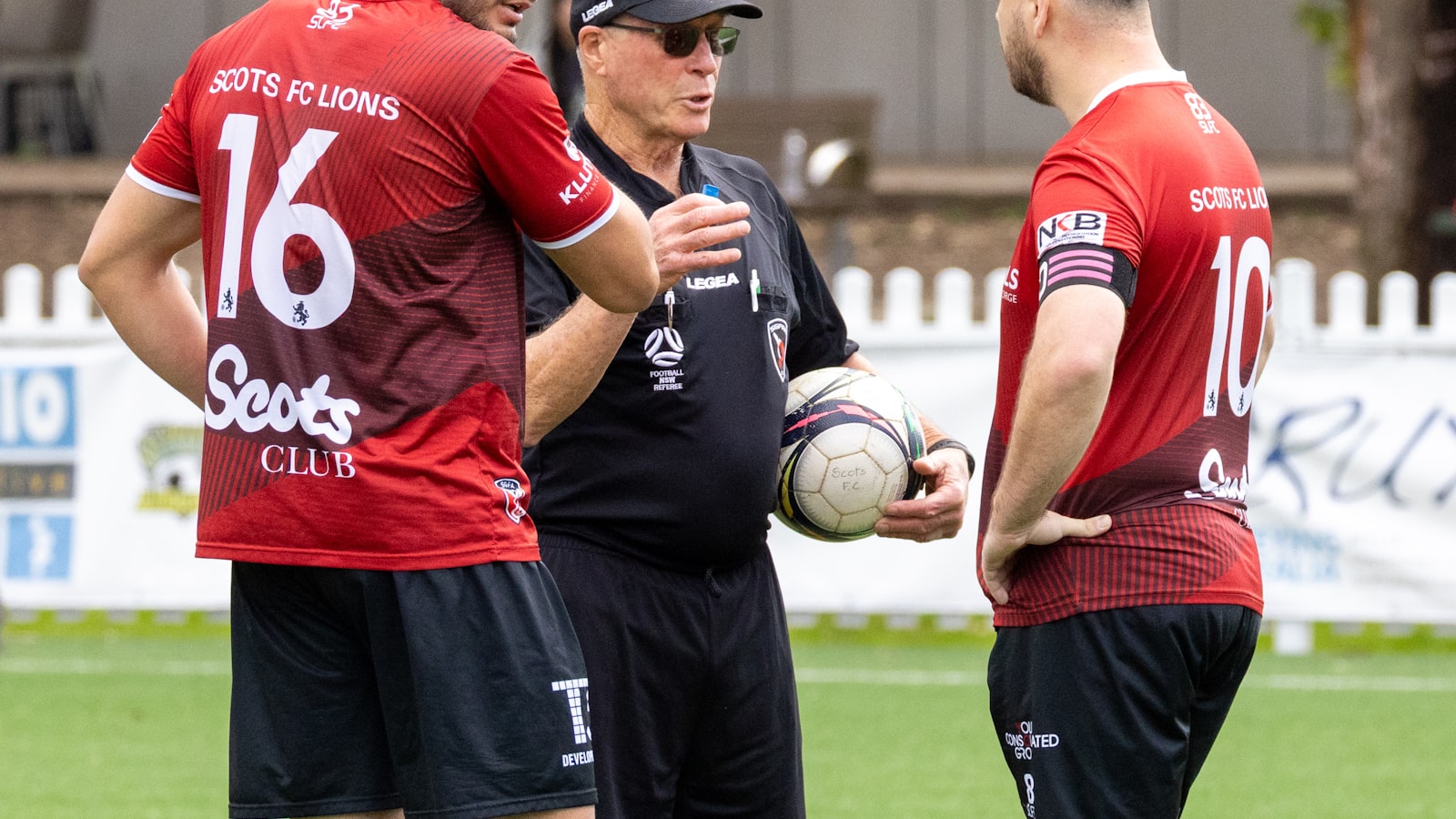
Referee makes the initial call on the pitch. VAR can only intervene on four match-changing categories: goals, penalties, direct red cards, and mistaken identity (MOI).
What is genuinely new for 2026
FIFA's technical division has confirmed three meaningful upgrades from Qatar 2022 to WC26, with a fourth under quiet trial. From the VAR changes between 2022 and 2026 piece, the offside-specific updates are:
- Multi-ball SAOT. At Qatar, only the active match ball was tracked. If a replacement ball was thrown in during a stoppage, the system needed a brief recalibration. At WC26, all balls available to a match (the active ball plus four reserves) are tracked simultaneously. The system always knows which ball is in play.
- Armpit precision tweak. A recurring 2022 complaint was that goals were disallowed by an attacker's shoulder being a centimetre ahead — when in reality the system was reading the upper arm. The 2024 calibration cleanly draws the offside-eligible body line at the lowest point of the armpit fold (matching the IFAB written law). FIFA expects this to overturn 2-4% fewer goals at the margin.
- In-stadium 3D animation in under 30 seconds. The Qatar broadcast graphic took 35-90 seconds to render. WC26's pipeline targets sub-30 seconds end-to-end, including the in-stadium display.
- Auto-flag delay protocol. Assistant referees have been instructed to delay the offside flag on goal-scoring chances unless the offside is blatant. The reasoning: don't kill a play prematurely if SAOT is going to overturn the flag anyway. This is a workflow change as much as a technical one, but referees who came up holding the flag at the first sign of doubt have had to retrain.
The calls that defined the technology
Two moments from 2022 are worth revisiting because they will be the lens through which fans interpret every close WC26 call.
Timo Werner-style ghost offside (Germany vs Spain, group stage, 2022). A first-half Germany goal was disallowed by SAOT after Antonio Rüdiger's run was flagged as offside. Broadcast replays showed Rüdiger ahead by what looked like a hair. The system was correct under the law. Fans were furious. The reaction marked the first time mainstream commentators argued the spirit of offside ("interfering with play from beyond the last defender") had been replaced by anatomical millimetre-counting.
Lautaro Martínez vs Saudi Arabia (group stage, 2022). Argentina had three first-half goals chalked off by SAOT in one of the great World Cup upsets. The system worked exactly as intended; Saudi Arabia's high defensive line was exquisitely timed. But the cumulative drama of three disallowed goals — combined with a Messi penalty in the same half — left a generation of Argentine fans convinced the technology was out to get them. (One year later, the same technology helped Argentina win the final cleanly.)
The lesson is not that SAOT is biased. It is that close calls feel different when they come from a machine. A linesman's flag is a human judgement; a SAOT line is a verdict. Fans grieve them differently.
“Semi-automated offside is not perfect. But it is the most accurate, fastest, and most consistent offside-decision tool football has ever had. Our job between now and 2026 is to make sure the fans in the stadium see what the system sees, at the same time the referee does.
”
Where SAOT can still get it wrong
Three failure modes are worth understanding before you tweet at a referee in June.
1. The ball-played moment. SAOT depends on knowing the exact instant the ball was kicked. On a deflected pass or a low-velocity flick, the IMU acceleration spike is shallow and the algorithm can pick the wrong frame. The system flags low-confidence calls back to the VAR official for manual frame selection.
2. Body-part identification on a crowd of players. When five defenders and four attackers are in the six-yard box on a corner, the 29-point skeletal model can briefly lose track of whose elbow belongs to whom. In Qatar this required a manual VAR override on roughly 1.5% of corner-derived offside checks.
3. Calibration drift. The cameras are calibrated to the pitch using fixed markers; any movement of the camera mounts (rare but possible after high-vibration concerts or events in the same venue between fixtures) can introduce sub-centimetre error. FIFA recalibrates at every venue before every match-day, but it is a non-zero risk.
The system is not infallible. It is, however, much harder to fool than a human eye — and infinitely more consistent.
The bigger debate
There is a school of thought, articulated most clearly by Arsène Wenger in his FIFA Football Innovation role, that says: the offside line should be the front of any body part of the second-last defender, but the attacker is only offside if a complete body part of theirs is beyond it — a "daylight" rule, like in some American sports. That would eliminate the centimetre call. It would also slightly increase the number of legitimately scored goals.
IFAB has declined to adopt the daylight rule for WC26. The argument: changing offside on the eve of a World Cup adds chaos, and the law's job is to be applied consistently, not to be ratings-friendly. But the debate is alive, and a single late-tournament daylight-rule moment in 2026 will reignite it.
For now, the law is what the law is. The system will measure to a centimetre. Goals will be given and disallowed by that centimetre. As you watch every tight WC26 build-up, remember: a flagged-offside delay is not the system failing — it is the system working.
SAOT — what do you actually know?
- 1. How many data points does SAOT track per player at WC26?
- 2. At what rate does the IMU sensor in the match ball transmit data?
- 3. What was the first match to use SAOT in a major FIFA tournament?
- 4. Which 2024 calibration upgrade addressed centimetre-thin disallowed goals?
- 5. Does SAOT make the final offside decision?
What to watch in June
Three things will define how SAOT is remembered after WC26:
- The first centimetre goal in the knockout rounds. It will happen. The discourse will be loud. Whether the system survives the news cycle with its credibility intact depends on how clearly FIFA explains the call in real time, which connects directly to VAR's new pitchside-announcement protocol.
- Group of Death encounters. With Italy, Brazil, and other elite sides facing pressure-cooker fixtures, expect tight defensive lines and a flurry of SAOT-checked goals. Our group of death 2026 preview outlines which matches are likeliest to test the system.
- The semi-final and final. History says the most controversial offside call of every World Cup arrives in the last four games. The system will earn its place — or lose it — on the biggest stage.
For everything else on the officiating modernisation around SAOT, see our companion pieces on stoppage-time reform and the new referee toolkit, plus the full VAR explainer for the underlying review process.
Frequently asked
What is semi-automated offside technology?
Why does the match ball have a sensor?
Is SAOT used at every WC26 venue?
How fast is a SAOT decision compared to old-style VAR offside?
Can SAOT get an offside call wrong?
What changed between Qatar 2022 and WC26?
Has IFAB adopted the 'daylight' offside rule?
Sources (5)
- FIFA — Semi-automated offside technologyaccessed 2026-05-20
- IFAB — Laws of the Game 2024-25accessed 2026-05-20
- The Athletic — How semi-automated offside worksaccessed 2026-05-20
- BBC Sport — World Cup VAR explaineraccessed 2026-05-20
- ESPN — FIFA's connected ball at the World Cupaccessed 2026-05-20
Sources (5)
- FIFA — Semi-automated offside technologyaccessed 2026-05-20
- IFAB — Laws of the Game 2024-25accessed 2026-05-20
- The Athletic — How semi-automated offside worksaccessed 2026-05-20
- BBC Sport — World Cup VAR explaineraccessed 2026-05-20
- ESPN — FIFA's connected ball at the World Cupaccessed 2026-05-20
You might also like