All 16 World Cup 2026 Stadiums, Ranked and Compared
From Estadio Azteca to MetLife, here is every World Cup 2026 stadium ranked by capacity, roof, climate, and matchday atmosphere — with the venues that will host the biggest games.
All 16 World Cup 2026 Stadiums, Ranked and Compared
You have 16 stadiums spread across three countries, four time zones, two oceans, one desert basin, one alpine plateau, and one retracting roof that costs more than some clubs. This is the largest World Cup ever staged, and for the first time the venue list reads like a tour of every climate, era, and architectural philosophy North American sport has produced over the last sixty years.
This guide ranks all sixteen World Cup 2026 stadiums the way a real fan thinks about them: capacity, roof, atmosphere, climate, transit, and the games they will actually host. We pulled the verified numbers (capacity, roof type, surface, year opened) from FIFA, the venue operators, and independent stadium databases, then layered the matchday context on top.
Use the map to orient yourself, then jump down to the deep dives on the five venues that matter most.
How we ranked them
Every venue has a job. A 92,000-seat retractable behemoth in north Texas is not trying to be a 45,000-seat lakeside ground in Toronto. So instead of one master list, we judged each stadium across five dimensions:
- Capacity in World Cup configuration. FIFA strips corner seats and adjusts sightlines so the pitch fits properly, which sometimes shaves a few thousand off the football number.
- Roof. Open, retractable, or fixed. This matters more than it sounds — see the Texas section below.
- Atmosphere. Bowl shape, steepness, history, and whether the local football culture is allowed to take it over.
- Climate. Late-June and July daytime highs at this venue. World Weather Attribution flagged five host cities as elevated heat-stress risk.
- Transit. Can a fan without a car get there from the city center?
We do not score these on a single 1–100 scale. We rank, compare, and call out who wins each category.
The capacity scoreboard
You will hear the word "biggest" thrown around all summer. Here are the verified World Cup configuration capacities, biggest to smallest, sourced from FIFA, Wikipedia, and venue operators.
A few observations before we get to the deep dives:
- The biggest by raw capacity is AT&T Stadium in Arlington, Texas, at roughly 92,967 to 94,000 in football configuration. That is bigger than the FIFA-published World Cup capacity of MetLife, which had 1,740 corner seats removed to accommodate proper pitch dimensions.
- The oldest is Estadio Azteca, opened in 1966 and now refreshed for its record third World Cup. It hosted the 1970 final, the 1986 final, and will host the 2026 opener.
- The newest is SoFi Stadium, opened in 2020, just outside Los Angeles in Inglewood.
- The smallest is BMO Field in Toronto at 45,736 — but that already includes around 17,000 temporary seats added specifically for the tournament.
16 WC26 Host Stadiums
Top 5: The headline acts
These are the five venues you will see most on television, the ones hosting either the highest-profile fixtures or simply the biggest crowds.
1. MetLife Stadium — East Rutherford, New Jersey
This is where the World Cup ends.
The FIFA-branded "New York New Jersey Stadium" hosts the 2026 final on July 19. It will run eight tournament matches in total. To meet FIFA's pitch dimensions, the operators removed 1,740 corner seats from the standard 84,240-seat football configuration, taking the World Cup capacity to 82,500. The natural-grass surface — Tahoma 31 Bermuda — began installation on May 8, 2026, replacing the artificial turf the New York Giants and Jets play on.
The roof is open. East Rutherford in mid-July averages a daytime high of around 28–30 °C (83–86 °F), and a 3 p.m. ET kickoff in an open bowl is one of the bigger climatic question marks of the tournament. The stadium sits roughly 8 km west of midtown Manhattan, accessible by NJ Transit rail straight from Penn Station to the dedicated Meadowlands stop.
It will not have the loudest local football culture in the tournament, but it will have the biggest single-night television audience in the history of the sport.
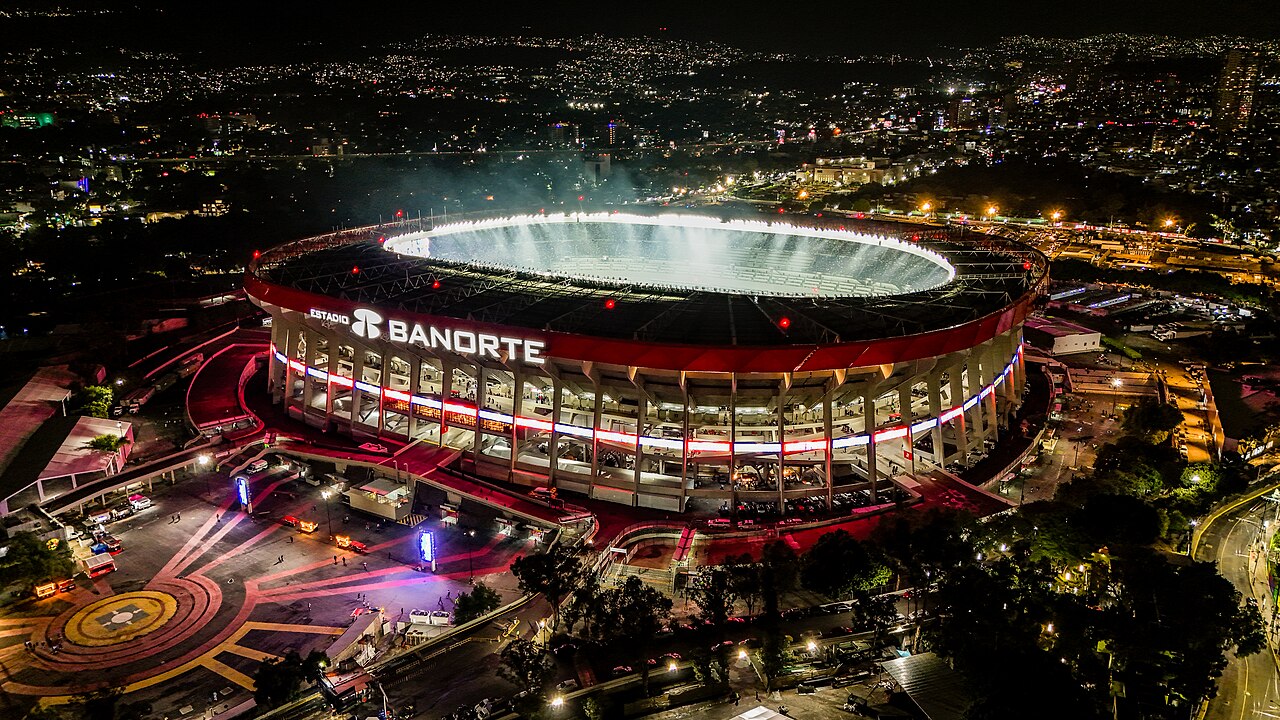
2. Estadio Azteca — Mexico City
The oldest venue at the World Cup is also, in many ways, the most important. Azteca already has the two greatest matches in World Cup history on its resume — the 1970 final (Brazil 4-1 Italy) and the 1986 quarter-final between Argentina and England, when Diego Maradona scored both the "Hand of God" and the "Goal of the Century" inside five minutes. In 2026 it becomes the first stadium ever to host games at three World Cups.
Capacity sits at roughly 87,500 after a renovation cycle, which makes it the second-biggest venue of the tournament. It hosts five matches, including the opener on June 11 between hosts Mexico and South Africa. The roof is open, the elevation is 2,240 meters — the highest of any World Cup venue — and afternoon thunderstorms in June are common.
Atmospherically, nothing else at WC26 will sound like Azteca. If you are watching the opener on TV, turn the surround sound up.
3. AT&T Stadium — Arlington, Texas
The biggest stadium on the schedule and the busiest. AT&T Stadium hosts nine matches, more than any other venue, including a semi-final. Capacity in World Cup configuration is between 92,967 and roughly 94,000 depending on the source. The 28,500-square-foot retractable roof and giant suspended video board make it the most cinematic indoor environment in football.
Dallas-Fort Worth is also one of the hottest places on the schedule. World Weather Attribution lists Dallas as one of five "elevated heat-stress" venues. The retractable roof can close, but FIFA scheduling logic plus the air conditioning load make Dallas day games one of the tactical X-factors of the group stage.
The pitch is a natural-grass overlay installed over the artificial turf used by the Dallas Cowboys. Transit is the rough edge: Arlington itself is car-dependent, with shuttle buses planned from Dallas and Fort Worth proper.
4. SoFi Stadium — Inglewood, Los Angeles
The architectural showpiece. SoFi opened in 2020 with a translucent fixed roof — not retractable, but transparent enough to let in California daylight while the open sides keep the air moving. Capacity in World Cup configuration is about 70,240, with a natural-grass overlay over the artificial surface used by the Rams and Chargers.
This is one of the better climate-controlled venues. Greater Los Angeles in late June sits at 24–27 °C (75–81 °F), and the marine layer keeps mornings cool. SoFi sits inside the Hollywood Park development with a metro stop opening on the K Line, plus shuttle service from LAX, about 6 km away.
5. Mercedes-Benz Stadium — Atlanta
The retractable roof in Atlanta is the most photographed in American sport — eight petal-like panels that open like an iris. Capacity in World Cup configuration sits around 71,000 on natural grass overlaid over the synthetic surface used by the Falcons and Atlanta United. Atlanta United have already shown that proper US soccer culture can fill this building beyond 70,000.
Atlanta is hot — typical late-June daytime highs of 31–33 °C (88–92 °F) with daily afternoon storm risk — so the retractable roof matters. The MARTA rail system runs to GWCC/CNN Center and Vine City, both within a five-minute walk, which makes this the most transit-friendly NFL-scale stadium on the schedule.
The biggest award goes to...
If you want the single number, it is AT&T Stadium in Arlington, at roughly 92,967–94,000 in football configuration. It will likely set the single-match attendance record of the 2026 tournament, and possibly of World Cup history.
But there is a footnote. Estadio Azteca, at about 87,500, is the largest pure-football bowl on the schedule (no NFL-first compromises, no temporary seating padding the number). And MetLife, at FIFA's published 82,500, hosts the largest meaningful crowd — the final.
So the three superlatives separate cleanly:
- Biggest stadium: AT&T
- Biggest football stadium: Azteca
- Biggest stage: MetLife (the final)
The mid-tier: same job, different vibe
Six venues sit in the 64,000–73,000 range and do the bulk of the group-stage work.
- Arrowhead Stadium, Kansas City — 73,000, open, natural grass since 1972. One of the loudest crowds in any sport when it gets going. The Chiefs' fans gave it its tilt; the Mexico and CONCACAF support will likely take it from there.
- NRG Stadium, Houston — about 72,220 with a retractable roof. Hot and humid outside, climate-controlled inside. Big Latino crowd locally.
- Levi's Stadium, Santa Clara — about 70,909 in the South Bay. Climate-mild, transit by VTA light rail or Caltrain.
- Lumen Field, Seattle — about 69,000, the loudest open-air stadium in the United States by published decibel readings. A partial canopy reflects sound down onto the field. Six matches, on a hybrid pitch upgraded specifically for the tournament.
- Lincoln Financial Field, Philadelphia — about 69,000, open, natural grass. The local Latin American support — particularly Mexican, Colombian, and Dominican — should be a feature.
- Hard Rock Stadium, Miami — about 65,000, open, natural grass. Hosts the third-place match on July 18. Latin American support is a baseline.
- Gillette Stadium, Foxborough — about 64,628, open, natural-grass overlay. Mild climate. Strong New England soccer culture going back two decades.
The small grounds
Three venues sit below 55,000.
- BC Place, Vancouver — about 54,500, with a retractable roof — the only one in Canada. Grass overlay over an artificial pitch. Mild climate; the coolest WC venue in late June (20–22 °C / 68–72 °F).
- Estadio BBVA, Monterrey — about 53,500, open, natural grass, home of Monterrey FC. Hot — daytime highs of 33–35 °C.
- Estadio Akron, Guadalajara — about 48,000, open, natural grass.
- BMO Field, Toronto — about 45,736 after a temporary-seating expansion of around 17,000 seats. Six matches. Open, natural grass, lakeside.
These smaller bowls are the underrated ones. Lower-seat-count crowds with steeper banks generate noise per cubic meter that the 90,000-seaters simply cannot match.
Temperature and roof analysis
If you are choosing where to be in person, climate is the single biggest variable. Typical late-June and early-July daytime highs (climatological normals, not 2026 forecasts) sorted by heat:
- Hottest: Arlington (34–36 °C), Houston (33–34 °C), Monterrey (33–35 °C).
- Hot: Atlanta (31–33 °C), Miami (31–32 °C), Kansas City (30–32 °C).
- Warm: Philadelphia (29–31 °C), NY/NJ (28–30 °C), Guadalajara (28–30 °C), Boston (26–28 °C).
- Mild: Toronto (24–27 °C), LA (24–27 °C), SF Bay (22–26 °C), Seattle (22–24 °C), Mexico City (22–24 °C).
- Coolest: Vancouver (20–22 °C).
Notice how the four retractable-roof venues line up with the temperature data: AT&T, NRG, and Mercedes-Benz are all in elevated-heat-risk cities. The fourth, BC Place, is in the coolest city — its roof is more about Pacific Northwest rain than heat.
Surface notes
FIFA requires every World Cup match to be played on natural grass. NFL stadiums that normally use artificial turf — MetLife, Mercedes-Benz, AT&T, NRG, Lumen, Levi's, SoFi, Gillette, Hard Rock — are installing natural-grass overlays for the tournament. The most-cited installation is Tahoma 31 Bermuda at MetLife, with work that started May 8, 2026. Lumen Field is targeting completion of its turf swap by end of May 2026.
Mexico City, Monterrey, Guadalajara, Toronto, Vancouver, Kansas City, Philadelphia, and Miami already play on grass or hybrid grass year-round.
Transit and airport notes
If you are flying in for a single match:
- Easiest by transit: Mercedes-Benz Stadium (MARTA), MetLife (NJ Transit from Penn Station), SoFi (LA Metro K Line, plus LAX shuttles), Lumen Field (Seattle's Link light rail goes door-to-door), BMO Field (Toronto's 509 streetcar).
- Car-required: AT&T Stadium (Arlington has no rail), Gillette Stadium (limited rail; MBTA Foxboro line runs only on game days), Arrowhead (limited transit, mostly bus shuttles).
- Mixed: Estadio Azteca (Línea 2 metro to Tasqueña, then Tren Ligero — works, but allow time).
Each city has at least one international airport within 30 km of the venue, with the partial exceptions of Foxborough (closer to Providence than Boston Logan) and Arlington (halfway between DFW and Dallas Love Field).
The full ranking, one more time
Here is the simplest version, ranked by World Cup matchday significance:
- MetLife — final
- AT&T — semi-final + 8 other matches (9 total)
- Estadio Azteca — opener + 4 others (5 total)
- Hard Rock — third-place match
- SoFi — early knockouts
- Mercedes-Benz — knockout fixtures
- NRG — group + knockout
- Arrowhead — group + knockout
- Levi's — group + knockout
- Lumen Field — six matches
- BMO Field — six matches (group + one knockout)
- Lincoln Financial Field — group stage
- Gillette — group stage
- BC Place — group stage
- Estadio BBVA — group stage
- Estadio Akron — group stage
Per-venue match counts for the bottom 11 venues come with a caveat: a fully reconciled count was not located in a single primary source as of mid-May 2026. Always cross-check FIFA's official fixture page for any specific game.
The final word
You will spend the next 39 days seeing every one of these buildings on television. A few — Azteca, MetLife, AT&T — will become permanent characters in the story of World Cup history. A few others — BMO, BBVA, BC Place — will steal scenes you do not expect. The thing every one of them shares is that natural-grass overlay, the FIFA-mandated pitch dimension, and a job to do for the largest World Cup ever staged.
Pick a venue, pick a match, and plan around the roof and the climate. The football will take care of the rest.
Frequently asked
Which stadium hosts the World Cup 2026 final?
What is the biggest World Cup 2026 stadium?
Where is the World Cup 2026 opening match?
How many World Cup 2026 stadiums have retractable roofs?
Do all the World Cup 2026 stadiums use natural grass?
Which stadium is the smallest at the World Cup 2026?
What is the highest-altitude World Cup 2026 venue?
Which World Cup 2026 stadiums are hottest in late June?
Sources (10)
- Wikipedia — 2026 FIFA World Cup (venues)accessed 2026-05-19
- FIFA — Dallas to host nine matchesaccessed 2026-05-19
- StadiumDB — MetLife preparationsaccessed 2026-05-19
- Outlook India — MetLife grass installaccessed 2026-05-19
- Football Ground Guide — Estadio Azteca renovationaccessed 2026-05-19
- BeIN Sports — All 2026 World Cup stadiumsaccessed 2026-05-19
- CBC News — BMO Field upgradesaccessed 2026-05-19
- King5 — Lumen Field upgradesaccessed 2026-05-19
- Sofascore — AT&T Stadium guideaccessed 2026-05-19
- World Weather Attribution — WC 2026 heat analysisaccessed 2026-05-19
Sources (9)
- Wikipedia — 2026 FIFA World Cup (venues)accessed 2026-05-19
- FIFA — Dallas to host nine matchesaccessed 2026-05-19
- StadiumDB — MetLife preparationsaccessed 2026-05-19
- Outlook India — MetLife grass installaccessed 2026-05-19
- Football Ground Guide — Estadio Azteca renovationaccessed 2026-05-19
- BeIN Sports — All 2026 World Cup stadiumsaccessed 2026-05-19
- CBC News — BMO Field upgradesaccessed 2026-05-19
- King5 — Lumen Field upgradesaccessed 2026-05-19
- World Weather Attribution — WC 2026 heat analysisaccessed 2026-05-19
You might also like